
 Image 1 of 2
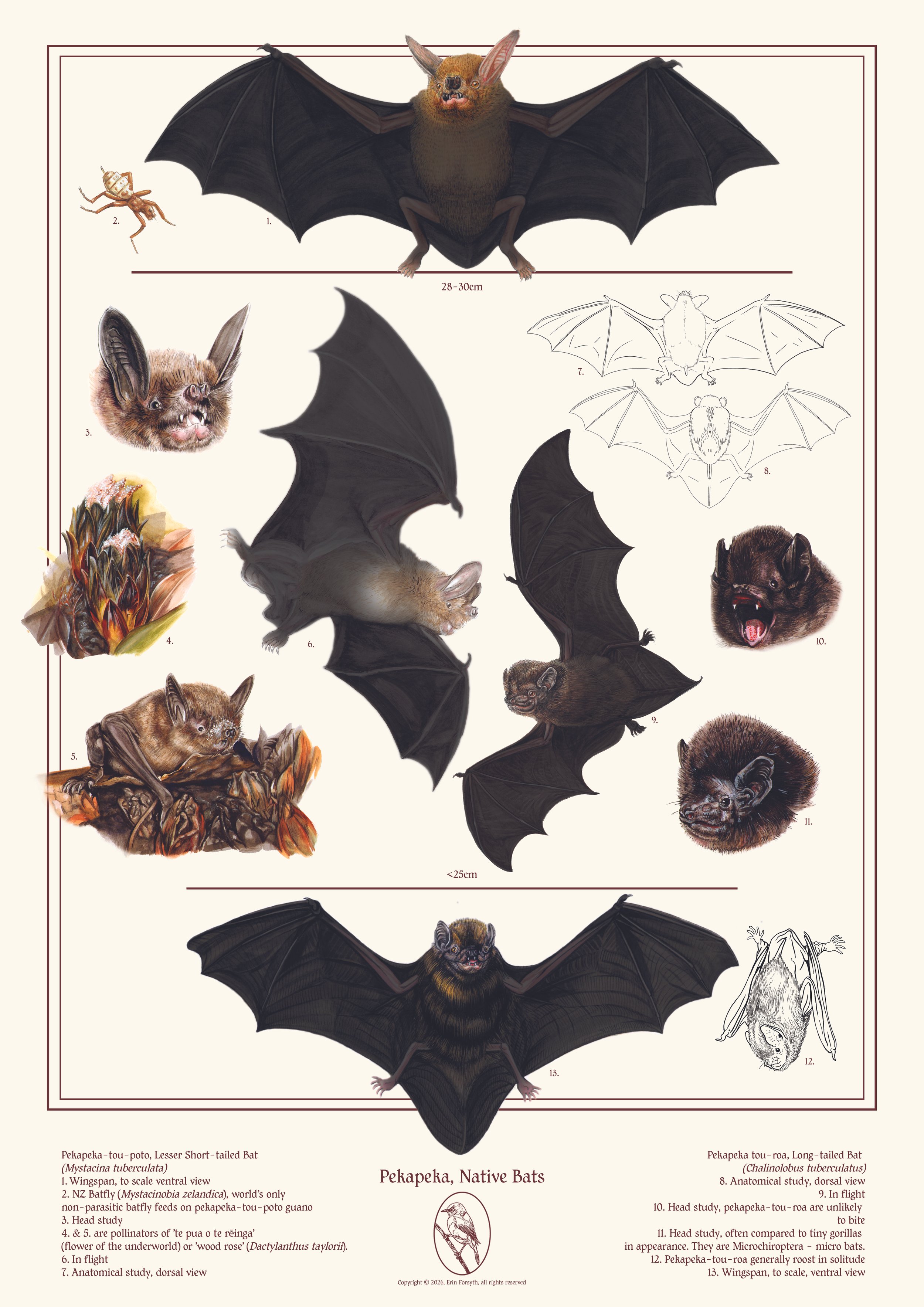 Image 2 of 2
Pekapeka fundamentals
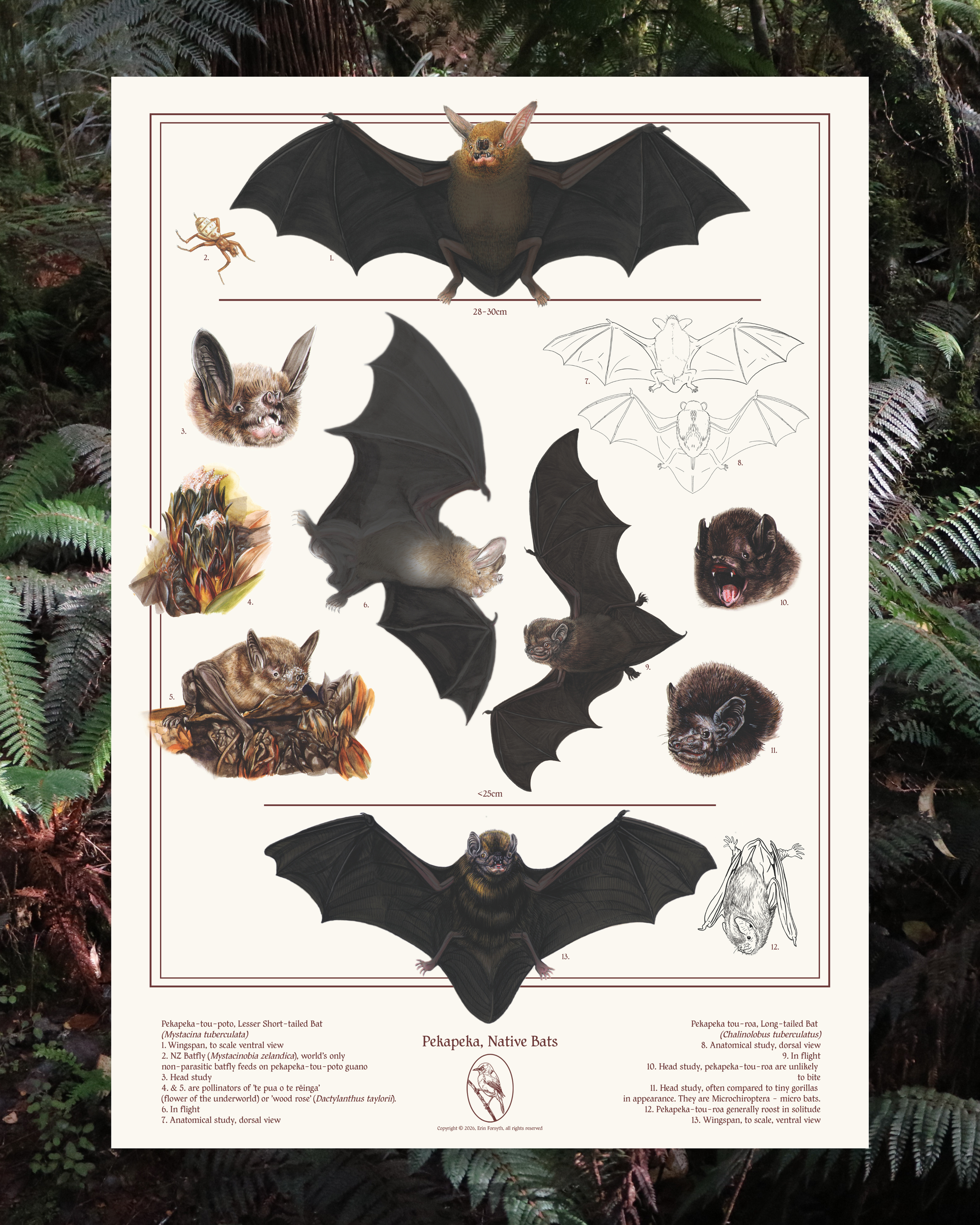
The only mammals known from Aotearoa pre-human settlement, survivors of lineages from Gondwanaland. Two species (both Critically Endangered) are known to survive but there’s evidence of more than 5. Pekapeka-tou-poto, lesser short-tailed bat (Mystacina tuberculata) and Pekapeka-tou-roa, long-tailed (Chalinolobus tuberculatus). Some hope the greater short-tail is out there…Both carry their young on their backs until capable of flight. Both can fold the leathery membrane of wing and tail to ‘walk’. The ‘thumbs’ at the peak of each wing aid this crawling motion.
Short-tails have short mousy fur and a good snout for ground foraging. Their bodies are around the size of a small kiwifruit. They are pollinators of te pua o te rēinga (flower of the underworld) aka wood rose (Dactylanthus taylorii).
Long-tails have faces like little gorillas. They are microbats belonging to Microchiroptera often confused for swallows in the early evening.
Short-tails, forage on the ground and are omnivorous. Long-tails prefer in flight - ‘on the wing’. Often using waterways like natural highways to move along. They are insectivorous.
Short-tails nest (roost) in large colonies, sometimes in their hundreds. Old hollow native trees of old growth forests are the best. Conservation groups use thermo imaging drones to locate such roosts in order to protect them. Long-tails tend to roost solo. Sometimes under the stringy bark of tōtara but have recently adapted to plantation pine forests and buildings.
A2 420 x 592mm Poster made on light-weight, uncoated classic matte paper. No minimum orders, printed and shipped on demand. Paper Finishing: Matte, smooth, non-reflective surface. Paper Weight: 170 gsm (65 lb), thickness: 0.19 mm (7.5 mils), sturdy and durable. Sustainable Paper: FSC-certified or equivalent for sustainability.
Pekapeka fundamentals
The only mammals known from Aotearoa pre-human settlement, survivors of lineages from Gondwanaland. Two species (both Critically Endangered) are known to survive but there’s evidence of more than 5. Pekapeka-tou-poto, lesser short-tailed bat (Mystacina tuberculata) and Pekapeka-tou-roa, long-tailed (Chalinolobus tuberculatus). Some hope the greater short-tail is out there…Both carry their young on their backs until capable of flight. Both can fold the leathery membrane of wing and tail to ‘walk’. The ‘thumbs’ at the peak of each wing aid this crawling motion.
Short-tails have short mousy fur and a good snout for ground foraging. Their bodies are around the size of a small kiwifruit. They are pollinators of te pua o te rēinga (flower of the underworld) aka wood rose (Dactylanthus taylorii).
Long-tails have faces like little gorillas. They are microbats belonging to Microchiroptera often confused for swallows in the early evening.
Short-tails, forage on the ground and are omnivorous. Long-tails prefer in flight - ‘on the wing’. Often using waterways like natural highways to move along. They are insectivorous.
Short-tails nest (roost) in large colonies, sometimes in their hundreds. Old hollow native trees of old growth forests are the best. Conservation groups use thermo imaging drones to locate such roosts in order to protect them. Long-tails tend to roost solo. Sometimes under the stringy bark of tōtara but have recently adapted to plantation pine forests and buildings.
A2 420 x 592mm Poster made on light-weight, uncoated classic matte paper. No minimum orders, printed and shipped on demand. Paper Finishing: Matte, smooth, non-reflective surface. Paper Weight: 170 gsm (65 lb), thickness: 0.19 mm (7.5 mils), sturdy and durable. Sustainable Paper: FSC-certified or equivalent for sustainability.